Rollicking Tracks (Part 3)
Standards for the essential dimensions of cartridges for turntables were established some time ago. For example, mounting screws should conform to thread sizes M2.5 and M2.6. However, much like with RIAA equalization curves, many manufacturers ignore these standards. For instance, the length of the stylus holder (dimension 9.5 on the diagram) can vary between 4 and 14 mm! It hardly seems worthwhile to discuss the other so-called “standard” dimensions of cartridges. Due to these discrepancies, mounting a cartridge onto the holder can often be quite a complex task. Moreover, the presence of long slots (to accommodate various stylus holder lengths) and wide slots (for differently-sized mounting screws) in the holder means that mounting the cartridge requires careful consideration of several parameters. For example, while adjusting the correction angle using a template, you also need to account for the potential change in the effective length of the tonearm (the distance from the vertical axis of the tonearm base to the stylus tip).
Manufacturers of tonearms strive to match the diversity of cartridge manufacturers in producing holders. These can range from large perforated ones to ultra-miniature designs, and from integrated constructions with the tonearm tube to those involving multiple spatial intermediate mounts. Furthermore, there are also self-aligning cartridge systems on the market.
Adding to the complexity are manufacturing inaccuracies. The platform beneath the cartridge, whether by itself or in relation to the principal rotational axes, is often significantly skewed. This defect is especially prevalent in tonearms with non-adjustable mounts, such as those integrated with the tonearm tube. For instance, in one relatively expensive tonearm, the flatness deviation was 1.2 mm! This required bonding an additional plate made of getinax and grinding the surface to be flat relative to both the horizontal rotation axis and the tonearm tube axis.
Older bayonet mounting systems, where the cartridge mounts to the holder which then attaches to the tonearm tube via bayonet clamps and an additional contact plate for tonearm wires, present even more challenges for adjustment. Recently, however, interest in this mounting method has increased due to the introduction of wooden holders.
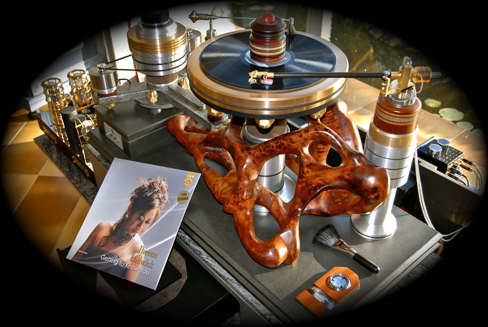
There are also various other methods of attaching holders to the tonearm tube. The image below features one of the finest tonearms from Simon Yorke, a manufacturer whose turntables are installed in the Library of Congress in the USA.
Now a bit of theory: reducing the moment of inertia of the tonearm positively impacts its performance. However, additional systems for adjusting and positioning the cartridge (such as sliding platforms, screws, connectors, etc.) located at the free end of the tonearm tube significantly increase its moment of inertia, thereby negatively affecting its performance. The stability of the entire system does not improve with the addition of numerous clamps and connectors. Therefore, preference should be given to well-made tonearms with a minimal number of adjustment mechanisms. Only DJ and similar tonearms require no adjustments at all.
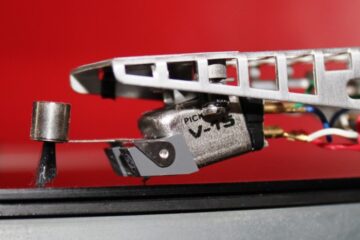
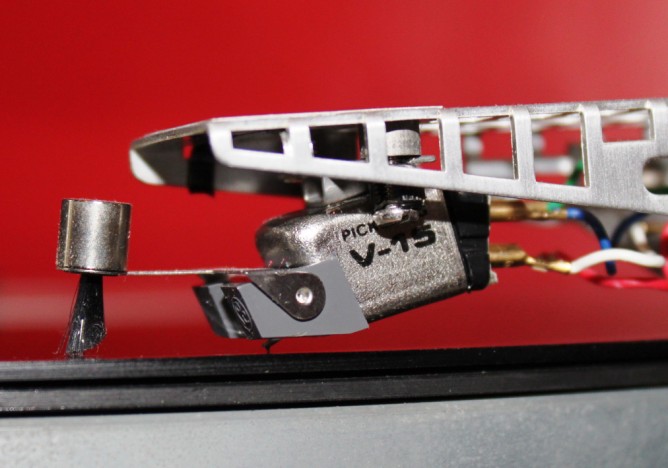
Over time, many types of tonearm suspensions have been invented: gimbal and unipivot designs, knife-edge and flat spring setups, thread suspensions, and more. A glance at patent pages online reveals an impressive array of designs. Currently, the gimbal and unipivot systems are leading. The gimbal suspension system is well-developed both theoretically and practically. Initially, it was made with sapphire axes borrowed from the watch and instrument industries, then with balls and cones, and nowadays, ball bearings are preferred. Ball bearings have an often-overlooked potential: bearings are usually not run in after assembly. Even though the movement of the tonearm rarely exceeds 35 degrees back and forth, running in the bearings shouldn’t be neglected. Why? The problem lies within the miniature elastic element of the stylus holder’s suspension, clearly visible in photographs. It’s through this element that the groove moves the entire tonearm! The moment of inertia of the tonearm, relative to the forces embedded in the elastic element, is tremendous. Ignoring additional friction forces in non-run-in suspension components isn’t advisable.