Rollicking Tracks (Part 1)
 Indeed, under high magnification, the modulated groove of a record does not even resemble a country road!
Standard limitations and comparisons often lead to extreme conclusions. For example, consider receiving a record valued at $500 from 1953, in excellent condition, but with no sound. Your other records play perfectly, but this one does not. The culprit is the lack of uniform recording standards in the past and the neglect of this specification today. Each studio recorded under its own patents and formats.
To bring this to light, let’s remember the different recording types:
- Vertical (or deep) cut: The needle moves up and down.
- Lateral (or horizontal) cut: The needle moves side to side.
- 45-degree (stereo) cut: Each channel is etched on one side of the 90-degree-angled groove.
Another vital element is the infamous RIAA equalization curve. Before the adoption of the IEC98 standard in 1987, there were roughly 150 different curves in use. Even today, many modern record producers overlook these standards.
Returning to our “silent” record, suppose it’s a lateral cut. You can identify this with a 50x magnifying glass – if the groove walls expand or narrow symmetrically, it’s vertical; if both walls zigzag parallelly, it’s horizontal; if each wall has its own curvature, it’s a 45-degree stereo cut.
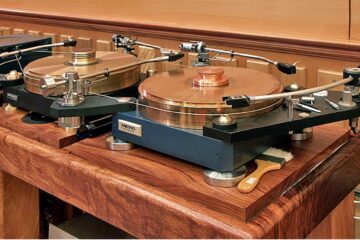
Let’s assume you have a stereo cartridge (coil positioning at 45 degrees) and a stereo RIAA equalizer. For stereo records to be played correctly, one channel must be inverted 180 degrees because stereo records use antiphase recording for the left channel. This setup only suits 45-degree records. Other systems require their corresponding heads and equalizers. Thus, when you see a turntable with multiple tonearms, it’s not just for show – it ensures proper playback of different records. Similarly, different equalizers are needed, equipped not only with head adjustments but also adaptable RIAA curve settings.
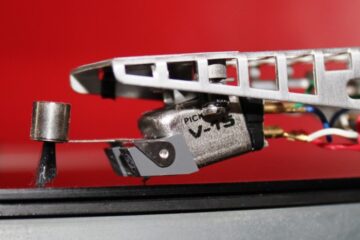
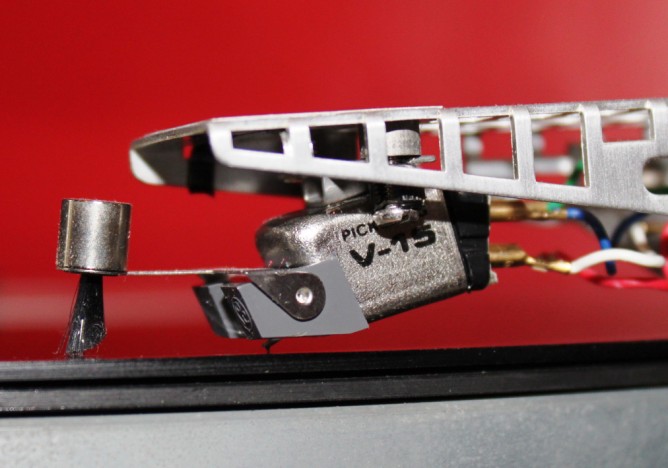
With a basic understanding of recording and playback systems, let’s touch on the age-old debate: MM versus MC cartridges. The main difference in sound, as often cited, stems from the varying weights of the moving systems, with moving magnet (MM) systems being heavier. However, this weight difference might not be as significant as presumed. Here are the real differences:
Mechanical Differences:
- Most MC (moving coil) cartridges use a second-class lever suspension system (like moving a log with a stick, where both forces are on one side of the fulcrum).
- Most MM cartridges use a first-class lever system (like a seesaw).
- MC cartridges typically have lower moments of inertia, improving their response.
Electrical Differences:
- MC cartridges generally produce less output than MM cartridges, meaning lower resistance to the needle’s motion in the groove, enhancing its performance.
-
- Suspension flexibility is crucial and noted in the cartridge specs – measured by deflecting the needle with a small dynamometer to 60 microns and dividing the force by this distance.
- While there are high-output MC cartridges, low-output MC variants are often preferred for their superior sound quality, despite needing expensive step-up transformers.
Here are some interesting statistics from industry standards:
- The needle travels at 1.833 km/h on the outer groove and 0.753 km/h on the inner groove, a difference of 2.433 times.
- A 20-minute audio track spans 862 meters.
- The needle’s maximum acceleration can reach 9.8 x 10³ m/s², or 1000 g!
- With an average clamping pressure of 2 grams, the needle exerts a pressure of 100 kg/mm² on the groove walls – equivalent to a 100-kg person standing on a pointed needle!
Vinyl records, and the associated playback systems, thus exhibit remarkable capabilities. Additionally, one millimeter of a vinyl record’s sound track contains far more musical information than a millimeter of a CD track!
Discover our range of turntables and find your perfect match today!